INSIDE A $6,000 SOFA
1. THE BELGIAN SLIPCOVERED SOFA: WHAT you actually get
I am going to take apart a sofa. Not as a tutorial in how sofas are made — though you will learn that. But as a way to show you what manufacturers hide, what they name, what they leave out of the paragraph.
The specimen is the Belgian Slipcovered Track Arm Bench-Cushion Sofa. $5,500–$7,200. It is one of the best sofas you can buy at that price. And even the best ones are lying to you on the website.
Here is what the gap looks like, and how to close it.
2. THE FRAME: THE BONES
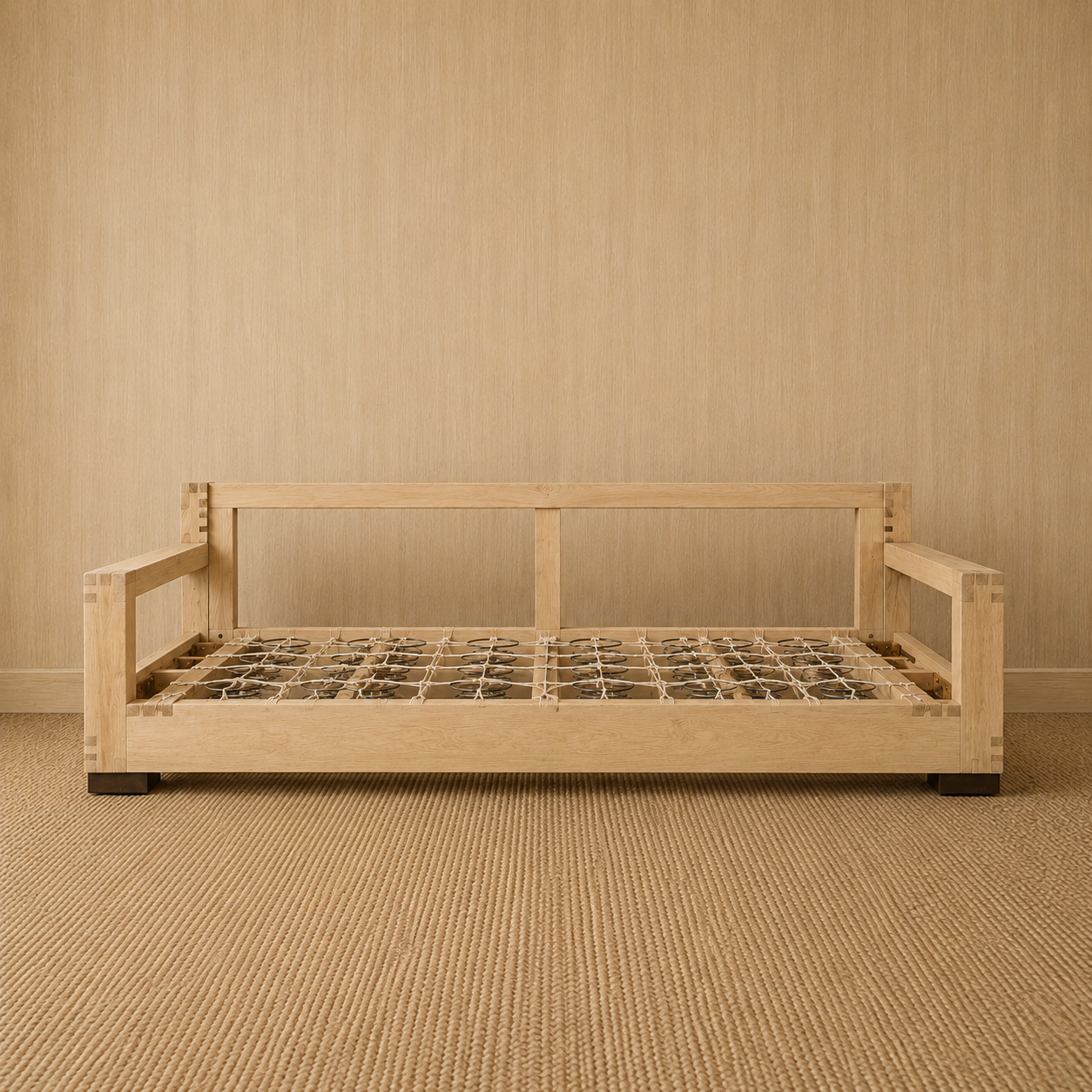
The frame is what holds the sofa together for the next fifteen years or holds it for three. It is the first place manufacturers cut.
RH says kiln-dried hardwood. The spec sheet says engineered wood. Those are not the same thing.
Kiln-dried hardwood means solid wood — oak, ash, or maple — baked down to 6–8% moisture content before it was cut. This matters. If you skip the kiln-drying, the wood keeps drying in your living room. The joints loosen. The panels split. The sofa develops a creak. The good frames do not move.
But engineered wood is plywood. Cheaper to mill, faster to build, but it does not hold a screw the way solid hardwood does. The joints fail earlier. You feel the difference in year four or five.
The joinery is the second signal. Mortise-and-tenon joints, glued and pinned — that is tradition. Stapled — that is the shortcut. Staples pop. Screws hold.
Look for corner blocks at every load point. Eight-way hand-tied springs put pressure on four corners and the center of the frame. If the corners are not reinforced, they rack — the frame gets a parallelogram look — and the cushions start to shift.
What you are reading for: hardwood named by species. Joinery that is glued and pinned, not stapled. Corner blocks at load points. A salesperson who can tell you the moisture content.
3. THE SUSPENSION: WHAT YOU SIT ON
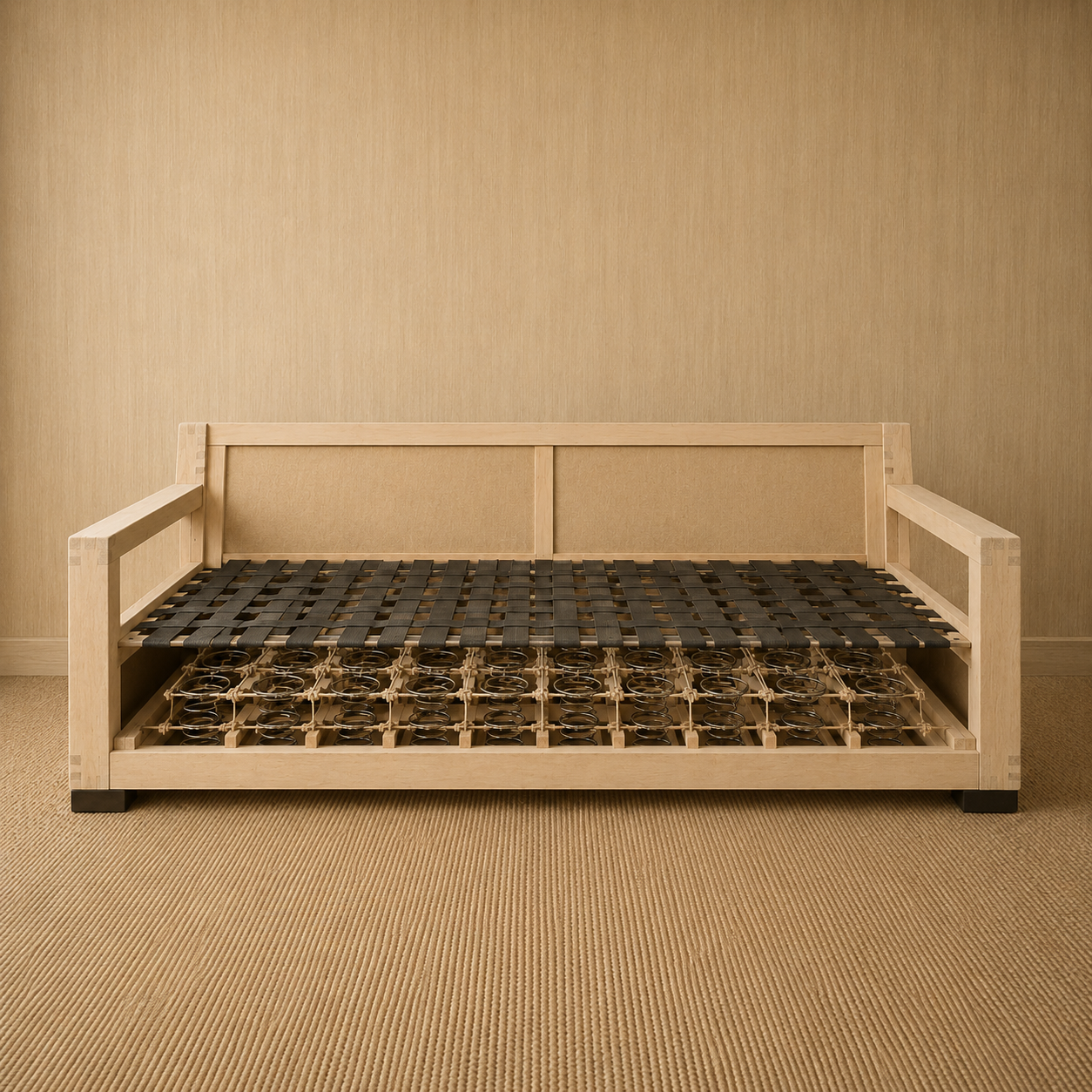
This is where the sit comes from. Two layers in a well-built sofa. Both matter.
Below: eight-way hand-tied coil springs. Above: woven webbing.
The coils give the flex and recovery. Each coil is tied to its neighbors in eight directions — front, back, sides, four diagonals. So when you sit, the whole deck compresses evenly. When you stand, it springs back as a unit. No dead spots. No center sag that gets worse every year.
Sinuous springs — the zigzag wire under most retail sofas — are cheaper. They are also noisier, shorter-lived, and they create a hammock effect. The center dips lower than the edges. Five years in, you are karate-chopping the cushions back into shape every time you sit.
The webbing above the springs is the platform the cushion rests on. It keeps the cushion from sagging through the springs over time. Jute or rubberized cotton, woven tight. If it is not there, or if it is there but loose, the foam will compress into the coil valleys and the sofa will feel used up within a few years.
What you are reading for: coils and webbing, not coils or webbing. Wire gauge in the low double digits — lower number means thicker steel, longer life. Jute or rubberized webbing, not nylon.
3 . THE CUSHION FILL: WHAT DETERMINES COMFORT
This is the decision that decides whether you love the sofa at year one or hate it by year two.
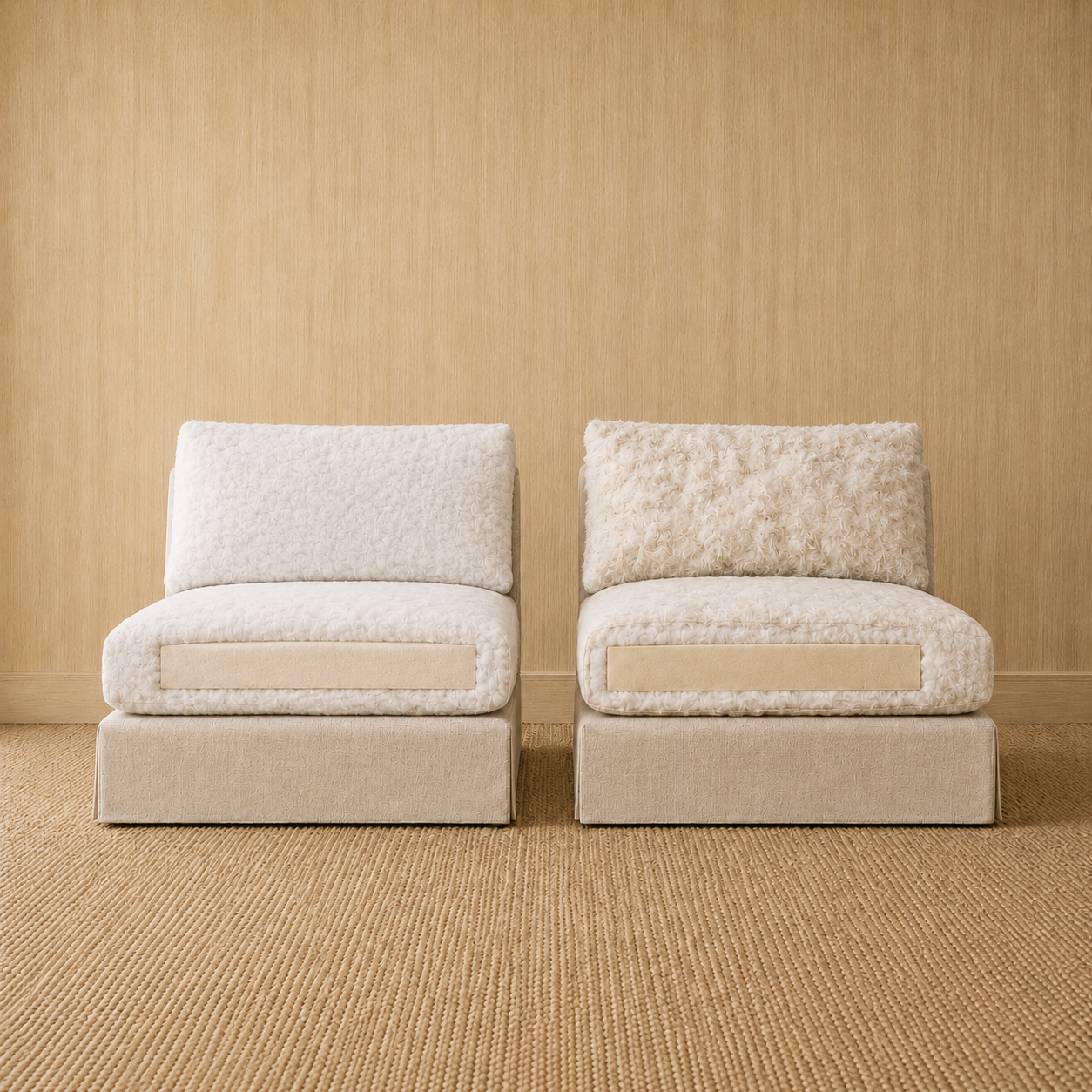
Three options: solid foam, down blend, or down-wrapped foam. RH offers the last two. Order the down-wrapped foam.
A down-wrapped foam cushion is a high-density foam core inside a baffled down envelope. The foam holds the shape. No body-print after a year. No center sag. No daily reset. The down gives the soft, broken-in feel of a fully down cushion without the shed, the smell, the migration, the maintenance.
Pure down is romantic and exhausting. Feathers migrate. Quills work through cheap ticking. The cushion flattens by Thursday and has to be punched back into place every time you sit. If you do want a fully down cushion, the detail that saves you is the ticking — a tightly woven cambric or downproof cotton shell that keeps the feathers in. Without it, the dust is guaranteed.
What you are reading for: foam density at 1.8 pounds per cubic foot minimum, 2.0 ideal. If you choose down-wrapped, ask the down-to-feather ratio. If you choose pure down, do not sign the invoice without seeing the ticking spec.
5. THE INNER UPHOLSTERY: THE LAYER NOBODY SEES
This is the batting and muslin between the frame and the cover. The part that decides whether your elbow lands on cushion or lands on wood.
It is also the layer manufacturers cut first when they need to hit a price.
Cheap sofas use a single thin pass of polyester batting. A well-built sofa layers cotton, wool, or blended batting over a polyester base. Then it sews the muslin in place. Staples work loose in a year and you feel every one of them.
Press hard on the arm of any sofa you are considering. If you feel the frame underneath, the inner upholstery is thin. You are paying for cushion you do not have.
What you are reading for: arms and back that absorb pressure without telegraphing the frame. Muslin that is sewn, not stapled. Natural-fiber batting in the outer layers.
6. The UPHOLSTERY: THE FACE
The cover is the layer the eye reads first and the only layer easy to replace.
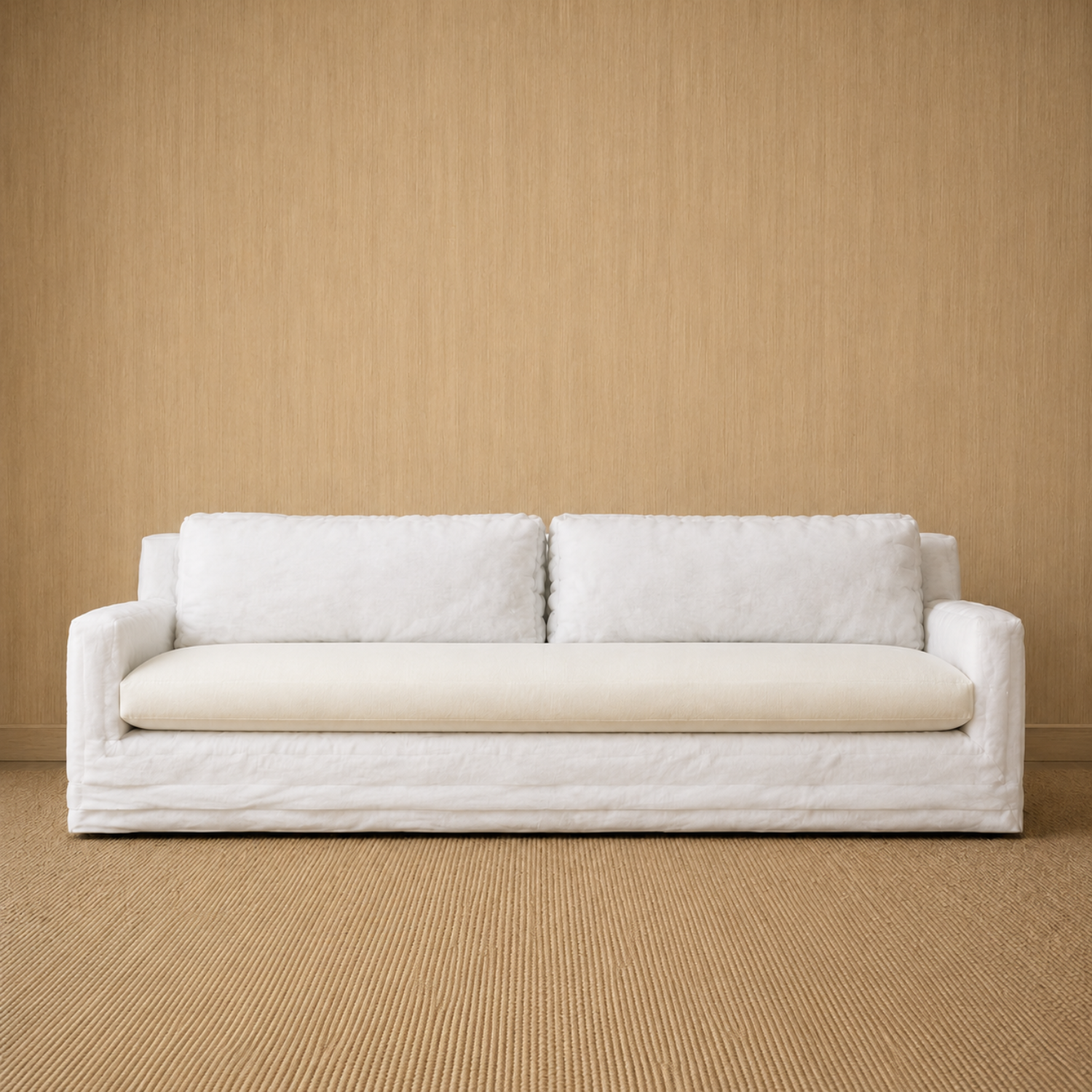
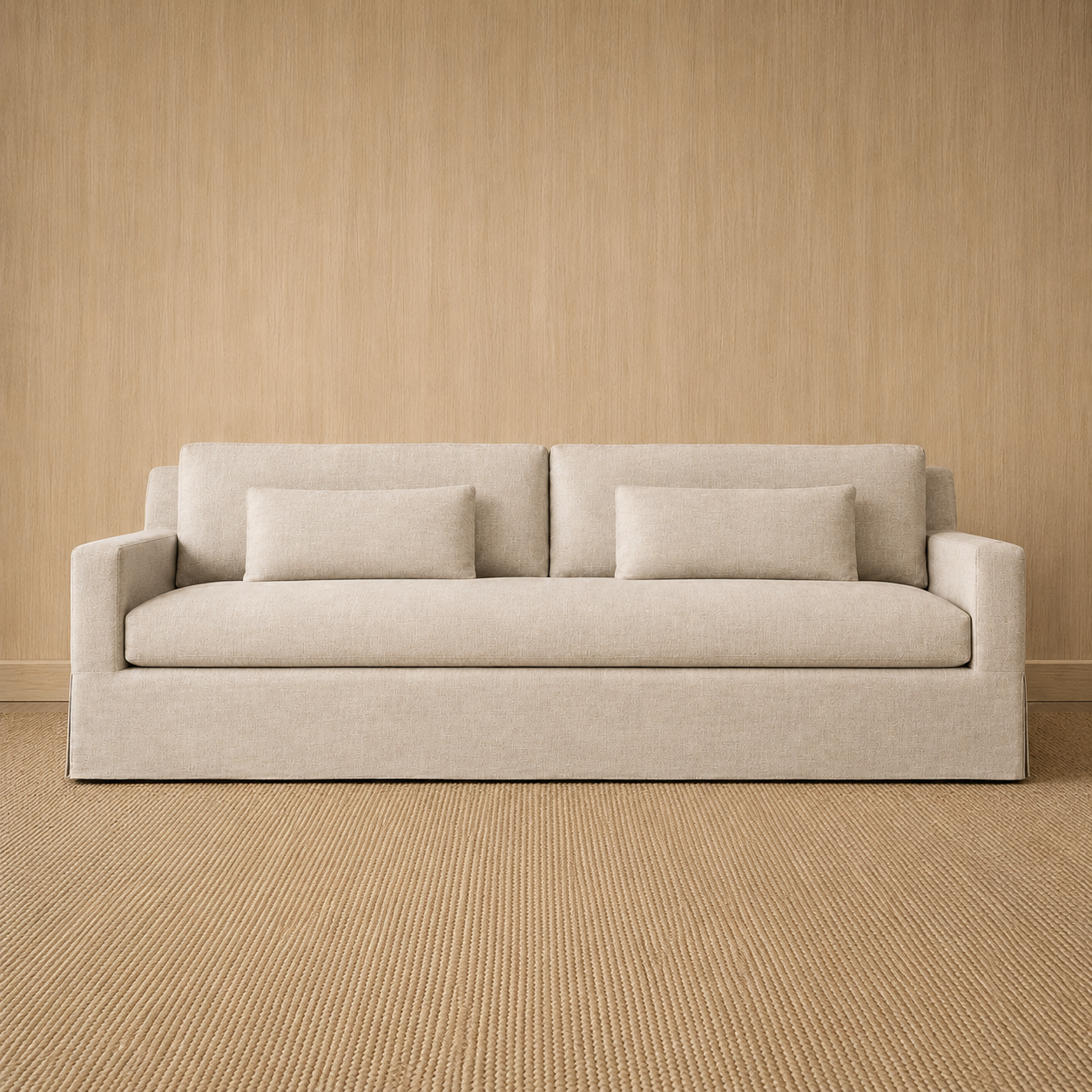
On the RH Belgian, a tailored linen slipcover — cut oversize, washed for softness, fitted with welted seams and ties underneath. Three things to read it by.
Tailoring: straight seams, crisp corners, welt cord aligned to the frame edge. Fabric weight: upholstery linen runs 12–16 ounces per yard. Lighter than that and it pills and pulls. Fit: loose enough to slip off and wash, tight enough that it does not slouch when you stand up.
Slipcovered sofas have one quiet advantage. At year five or six, re-stuffing the cushions is a $40 fix. Pop the cover, open the cushion zipper, add a layer of down, zip it shut. The sofa resets. You do not buy a new one.
What you are reading for: heavy linen or performance weave, welted seams, ties or hooks underneath, generous seam allowances so the cover can be re-fitted if anything shifts.
WHAT RH DOES NOT TELL YOU
The marketing copy says kiln-dried hardwood. Master craftsmen. Heirloom-quality.
The spec sheet says engineered wood.
The prose sells tradition. The spec sells something cheaper, and does not name what.
The same gap runs through the rest of the page. Every layer has a truth and a marketed version. Walk into the gallery and ask your salesperson these eight questions. The website will not answer them. They have to.
Is the frame engineered wood or solid hardwood, and what species?
What wire gauge are the springs, and is there webbing across the deck above them?
What is the foam density of the cushion core, in pounds per cubic foot?
On the Down-Feather upgrade, what is the down-to-feather ratio, and is the ticking down-proof?
Is the inner muslin sewn or stapled to the frame?
What is the fabric weight, in ounces per yard, for the linen I am choosing?
Why is the Classic 40" depth shallower (15") than the Petite 36" (18")?
Guaranteed for Life — what does the warranty actually cover, and may I see the document?
If the salesperson can answer all eight from memory or by pulling the spec card, the sofa is built. If you get fog on any one, that is the layer the manufacturer cut. You are paying for the four they kept and the slipcover that hides the fifth.
THE BREAKDOWN is the ingredient list for furniture: what is inside the things we live with, what was built well, what was quietly cut, and what you are actually paying for.
NOTE: Unsponsored. RH does not offer affiliate commissions; this is independent analysis.